

Keeping up with the military industry news from the world
Provided by AGP
Cedarburg taxpayers face legal tab in Gauthier pond dispute
May 7, 2026
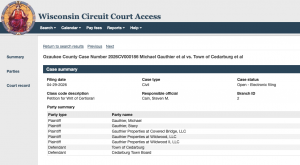
By AI, Created 10:07 AM UTC, May 20, 2026, /AGP/ – Mike and Stacy Gauthier have filed a court challenge to Cedarburg’s unanimous denials of their 13.2-acre pond proposal, putting the Town’s legal defense costs on local taxpayers. The case tests a long public process over zoning, land division and pond permits, and could take months to resolve.
Why it matters: - Cedarburg residents will pay to defend the Town’s land-use decisions in court. - The case could shape how Wisconsin towns handle large private pond projects, zoning authority and permit timing. - The dispute has already driven new town rules limiting man-made ponds to five acres.
What happened: - Mike and Stacy Gauthier filed Ozaukee County Circuit Court Case No. 2026CV000186 on April 29, 2026, challenging Cedarburg’s denials of their 13.2-acre private pond proposal. - The Town of Cedarburg Plan Commission unanimously recommended denial on Dec. 17, 2025. - The Town Board then denied three required approvals on a 5-0 vote on Feb. 4, 2026: rezoning, a Certified Survey Map and a pond permit. - The Town will defend those votes using the municipal budget.
The details: - The Town Board’s Feb. 4 minutes cite three main reasons for denial: the pond was not a permitted use in the A-1 Agricultural Zoning District, the pond did not qualify as an accessory use, and the applicants changed the project substantially after the hearing deadline. - The minutes state the project lacked an existing single-family dwelling to support the pond as an accessory use for a residence. - Town records say the proposed pond was presented as recreational and intended for boating and water skiing. - The Town’s meeting transcript records Presiding Supervisor Thomas Esser saying the proposed use was recreational and, later, that the presented purpose was water skiing. - Town Attorney Brad Hoeft said the earlier fish pond permit was a type 2 permit for personal consumption and use, not an agricultural permit, and that it was not part of the application at issue. - The Town Planner’s staff report said the applicants had not indicated the pond would be used for any agricultural-related purposes. - CBS 58 reported that plan commissioners also raised concerns that the pond could lead to air or water pollution. - On Jan. 23, 2026, the Gauthiers’ attorney withdrew the rezoning petition and submitted revised engineering plans the week before the final Board meeting. - The revised plans switched the water source from Cedar Creek to a high-capacity well. - Town Planner Amy Barrows said staff had not had time to fully review the new materials. - Town Engineer Troy Hartjes said he had not reviewed the altered engineering documents received one week before the meeting. - The updated plans did not include detailed well and piping information. - In the same Jan. 23 letter, the Gauthiers’ attorney argued the Certified Survey Map was automatically approved under Wisconsin law because the Town had not acted within 90 days. - Hoeft presented 161 pages of communications showing the applicants agreed to every public meeting date during the process. - The Town Board later adopted Ordinance 2026-5, limiting man-made ponds to five acres. - A Town staff inventory found 168 existing ponds in Cedarburg, with 97% smaller than five acres and an average size of 0.95 acres.
Between the lines: - The Town’s case appears stronger now than at the time of the denial because Cedarburg has since codified a five-acre pond cap tied to existing land-use patterns. - The fish-farm argument appears to have surfaced late in the process, while Town records say the application itself described a recreational project. - The switch from surface water to a high-capacity well, filed just before the vote, gave the Town a fresh procedural argument about incomplete review. - A certiorari challenge is narrow. The court reviews whether the Town stayed within its authority, followed the law, acted reasonably and had substantial evidence. - The court does not retry the dispute or hear new evidence.
What’s next: - The circuit court will review the Town’s decisions under Wisconsin’s certiorari standard. - These cases often take 6 to 18 months to resolve, which means Cedarburg’s legal costs could continue through that period. - Drilling and high-capacity well work began within days of the denial under a separate Wisconsin Department of Natural Resources approval, even though the pond itself had no Town permits. - TMJ4 reported the drilling on Feb. 8, 2026, and the Milwaukee Journal Sentinel followed in March 2026.
The bottom line: - Cedarburg’s pond fight has moved from local boards to court, with taxpayers funding the defense and a judge now set to review whether the Town followed state law and its own code.
Disclaimer: This article was produced by AGP Wire with the assistance of artificial intelligence based on original source content and has been refined to improve clarity, structure, and readability. This content is provided on an “as is” basis. While care has been taken in its preparation, it may contain inaccuracies or omissions, and readers should consult the original source and independently verify key information where appropriate. This content is for informational purposes only and does not constitute legal, financial, investment, or other professional advice.
Sign up for:
Military Industry Today
The daily local news briefing you can trust. Every day. Subscribe now.
Check Your Email!
We sent a one-time activation link to: .
Confirm it's you by clicking the email link.
If the email is not in your inbox, check spam or try again.
Welcome back!
is already signed up. Check your inbox for updates.