
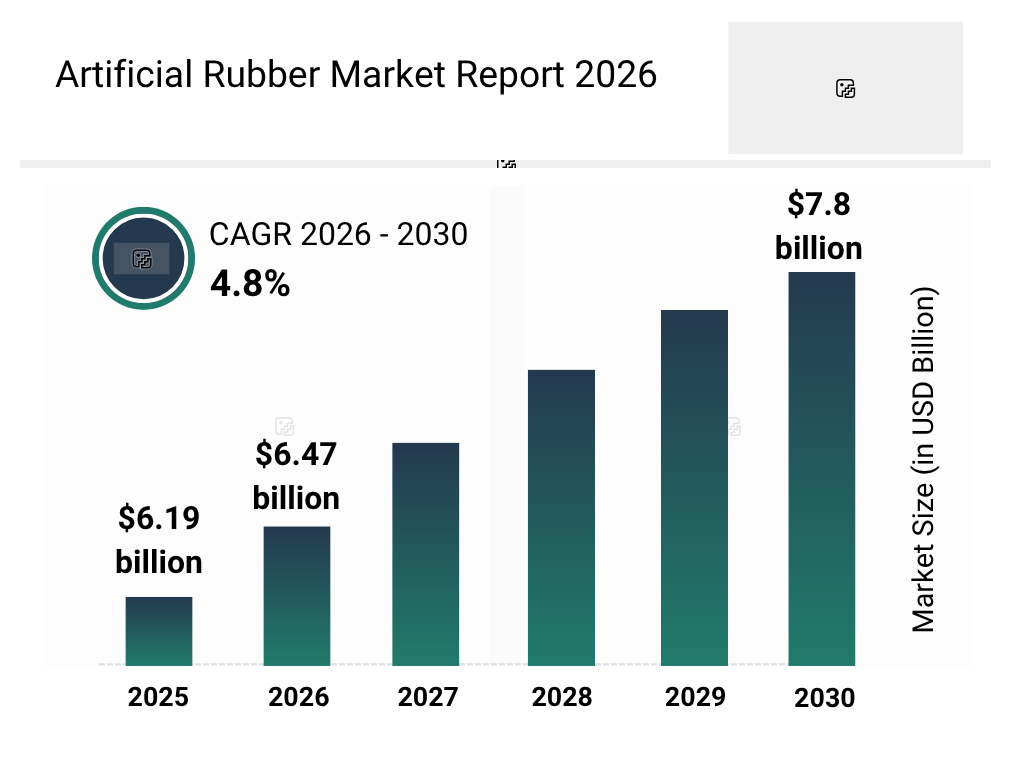
The Artificial Rubber Market is projected to grow at a CAGR of 4.8%, reaching a value of $7.8 billion by 2030.
Artificial Rubber Market Share

The Business Research Company
The Business Research Company’s Artificial Rubber Global Market Report 2026 – Market Size, Trends, And Forecast 2026-2035
LONDON, GREATER LONDON, UNITED KINGDOM, September 28, 2026 /EINPresswire.com/ -- The artificial rubber industry has witnessed consistent growth over recent years, driven by key sectors relying heavily on synthetic elastomers. As demand continues to rise across various applications, this market is set to experience further expansion. Let’s explore the current market size, main growth catalysts, leading regions, and the trends shaping the future of artificial rubber.
Current Market Size and Growth Outlook for the Artificial Rubber Market
The artificial rubber market has steadily increased in value, reaching $6.19 billion in 2025. It is projected to grow to $6.47 billion by 2026, representing a compound annual growth rate (CAGR) of 4.6%. This rise during the historical period is largely tied to surging automotive production, increased tire manufacturing, expanding industrialization, and infrastructure projects. Additionally, more machinery and equipment are incorporating rubber components, while demand grows for durable sealing and insulation materials. The gradual replacement of natural rubber with synthetic varieties has also supported this steady growth.
Download a free sample of the artificial rubber market report:
https://www.thebusinessresearchcompany.com/sample_request?id=29531940&type=smp&name=Artificial%20Rubber%20Market%20Report%202026&utm_source=EINPresswire&utm_medium=Paid&utm_campaign=Sep_PR
Looking ahead, the market is expected to maintain this upward momentum, reaching $7.8 billion by 2030, with a slightly higher CAGR of 4.8%. Key factors fueling this forecast include a growing need for tires tailored to electric vehicles and automotive elastomer parts, wider use of high-performance rubber in aerospace and defense, and a rising demand for chemical- and heat-resistant rubber products. The healthcare sector is also expanding its use of synthetic elastomers in medical devices. Sustainability concerns are encouraging the development and adoption of recyclable and bio-based synthetic rubber materials. Leading trends feature specialty synthetic rubbers for demanding applications, lightweight, durable elastomers in industrial products, and advances in polymer blending to customize rubber properties for better chemical resistance and temperature stability.
Understanding Artificial Rubber and Its Unique Attributes
Artificial rubber, also known as synthetic rubber, is a petrochemical-derived elastomer designed to replicate the elasticity of natural rubber. Unlike natural rubber, its manufacturing process offers more consistent quality and scalability, not dependent on agricultural conditions. Synthetic rubber can be engineered for specific performance traits such as enhanced durability, superior heat resistance, and improved chemical stability, making it highly valuable across many industries.
View the full artificial rubber market report:
https://www.thebusinessresearchcompany.com/report/artificial-rubber-market-global-report?utm_source=EINPresswire&utm_medium=Paid&utm_campaign=Sep_PR
Key Factors Behind the Growing Demand for Artificial Rubber
One of the primary drivers of the artificial rubber market is the increasing production of automobiles worldwide. The automotive manufacturing process involves assembling vehicles like cars, trucks, and buses from raw materials and parts. Rapid urbanization fuels this growth, as more people moving to cities boosts the need for personal and commercial transportation. Artificial rubber plays a crucial role by supplying durable, heat- and wear-resistant components including seals, hoses, tires, and vibration-damping parts that enhance vehicle safety, efficiency, and longevity.
Supporting this trend, data from the International Organization of Motor Vehicle Manufacturers (OICA) revealed that global motor vehicle production climbed from 85,016,728 units in 2022 to 93,546,599 units in 2023—a rise of roughly 8.5 million vehicles. This significant uptrend clearly contributes to the expanding demand for synthetic rubber materials within the automotive sector.
Asia-Pacific Positioned as the Leading Market for Artificial Rubber
In 2025, Asia-Pacific held the largest share of the artificial rubber market globally. This region is also expected to demonstrate the fastest growth during the forecast period. Alongside Asia-Pacific, the market report includes vital regions such as South East Asia, Western and Eastern Europe, North and South America, the Middle East, and Africa, offering a thorough view of global market dynamics. The rapid industrialization and automotive expansion in Asia-Pacific support its leading position and promising growth trajectory in the coming years.
What’s included in our 2026 market reports:
• Market attractiveness scoring and analysis
• Total addressable market (TAM) analysis
• Company scoring matrix graphics and tables
• Excel-based forecasting dashboards
• Market hotspots infographics
• Key technologies and future trend analysis
• Updated graphics and tables
Speak With Our Expert:
Saumya Sahay
Americas +1 310-496-7795
Asia +44 7882 955267 & +91 8897263534
Europe +44 7882 955267
Email: marketing@tbrc.info
The Business Research Company - www.thebusinessresearchcompany.com
Follow Us On:
• LinkedIn: https://in.linkedin.com/company/the-business-research-company
Oliver Guirdham
The Business Research Company
+44 7882 955267
email us here
Visit us on social media:
LinkedIn
Facebook
X
Legal Disclaimer:
EIN Presswire provides this news content "as is" without warranty of any kind. We do not accept any responsibility or liability for the accuracy, content, images, videos, licenses, completeness, legality, or reliability of the information contained in this article. If you have any complaints or copyright issues related to this article, kindly contact the author above.
