

According to the Latest Research by The Business Research Company, the Global Three-Dimensional (3D) and Four

The Business Research Company
Three-Dimensional (3D) and Four-Dimensional (4D)
The Business Research Company’s Three-Dimensional Global Market Report 2026 – Market Size, Trends, And Forecast 2026-2035
LONDON, GREATER LONDON , UNITED KINGDOM, October 23, 2026 /EINPresswire.com/ -- The demand for advanced military radar technologies has been steadily increasing, driven by the need for enhanced surveillance and defense capabilities. As nations modernize their defense infrastructure, the three-dimensional (3D) and four-dimensional (4D) military radars market is set to experience significant growth in the coming years. Let’s explore the current market landscape, key growth factors, leading regions, and promising trends shaping this vital sector.
Current and Future Market Size of the 3D and 4D Military Radars Market
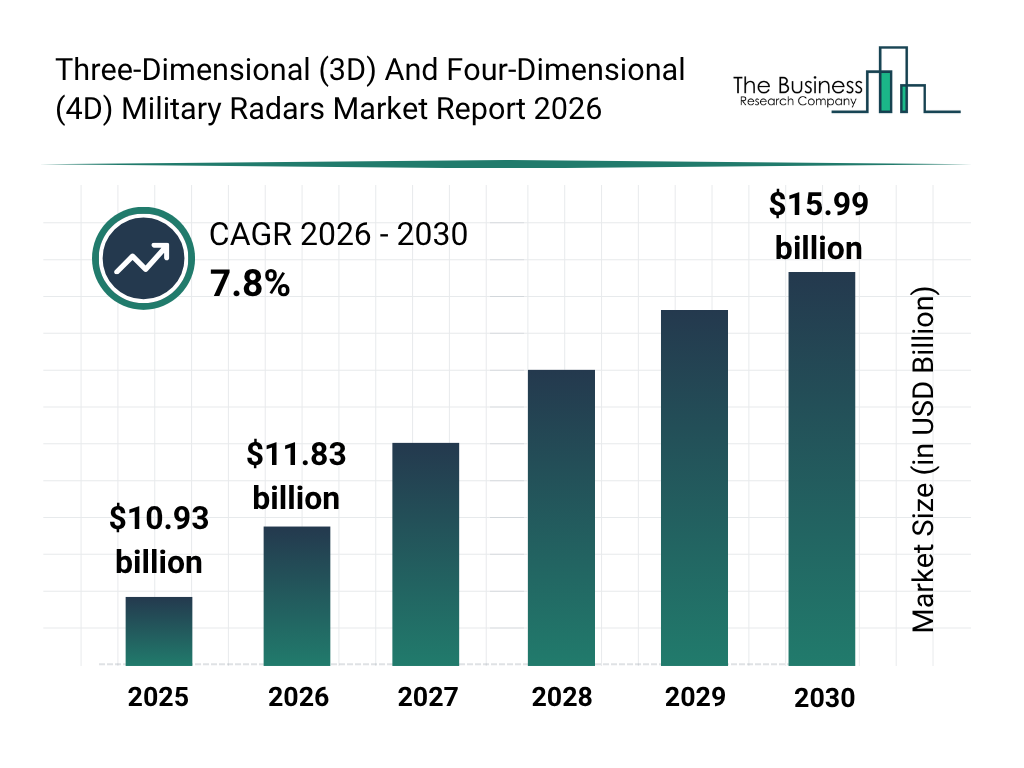
The three-dimensional (3D) and four-dimensional (4D) military radars market has witnessed strong expansion recently. It is projected to grow from $10.93 billion in 2025 to $11.83 billion in 2026, reflecting a compound annual growth rate (CAGR) of 8.2%. Driving this growth in the past years are factors such as increasing demand for real-time military surveillance, ongoing modernization of radar systems, wider adoption of phased array radar technology, a heightened focus on battlefield situational awareness, and greater requirements for precise target detection and tracking.
Download a free sample of the three-dimensional (3d) and four-dimensional (4d) military radars market report:
https://www.thebusinessresearchcompany.com/sample_request?id=13750772&type=smp&name=Three-Dimensional%20%283D%29%20And%20Four-Dimensional%20%284D%29%20Military%20Radars%20Market%20Report%202026&utm_source=EINPresswire&utm_medium=Paid&utm_campaign=Oct_PR
Looking ahead, the market is expected to continue its robust upward trajectory, reaching $15.99 billion by 2030 with a CAGR of 7.8%. This expansion will be fueled by rising interest in next-generation multifunction radar systems, deployment of high-frequency radar technologies, growing use of gallium nitride radar components, and increased demand for improved low-observable target detection. In addition, advanced electronic warfare integration will play a key role. Notable trends include the broader adoption of active electronically scanned array radar systems, enhanced digital beamforming capabilities, increasing development of multifunction radar platforms, and a stronger focus on high-precision target tracking.
Understanding 3D and 4D Military Radars and Their Capabilities
Three-dimensional (3D) and four-dimensional (4D) military radars represent sophisticated radar technologies that provide comprehensive detection, tracking, and monitoring of targets. They measure critical parameters such as range, azimuth, elevation, and in the case of 4D radars, target velocity. These systems rely on advanced signal processing, phased array technology, and digital beamforming to deliver highly accurate situational awareness, supporting real-time surveillance, threat identification, and battlefield monitoring within complex operational scenarios.
View the full three-dimensional (3d) and four-dimensional (4d) military radars market report:
https://www.thebusinessresearchcompany.com/report/three-dimensional-3d-and-four-dimensional-4d-military-radars-market-report?utm_source=EINPresswire&utm_medium=Paid&utm_campaign=Oct_PR
Global Military Spending as a Key Driver for the 3D and 4D Military Radars Market
One of the primary factors propelling the growth of the 3D and 4D military radars market is the rising global military expenditure. This spending covers government budgets allocated to armed forces, defense equipment, military operations, research and development, and other defense-related activities intended to ensure national security and military readiness. The increase in military spending is largely driven by escalating geopolitical tensions, which compel countries to strengthen their defense capabilities, modernize forces, and expand their security infrastructure. This, in turn, fosters investment in advanced radar technologies that enhance air surveillance, target detection, missile defense, and battlefield awareness.
To illustrate, the Stockholm International Peace Research Institute (SIPRI), an independent international organization based in Sweden, reported that global military expenditure reached $2.72 trillion in 2024. This figure represents a 9.4% increase in real terms compared to 2023, highlighting the growing financial commitment to defense and the resulting positive impact on the 3D and 4D military radars market.
Leading Regional Markets for 3D and 4D Military Radars
In 2025, North America held the largest share of the three-dimensional (3D) and four-dimensional (4D) military radars market. However, the Asia-Pacific region is positioned to emerge as the fastest-growing market during the forecast period. The comprehensive market analysis encompasses key regions including Asia-Pacific, South East Asia, Western Europe, Eastern Europe, North America, South America, the Middle East, and Africa, providing a global perspective on the evolving demand and opportunities in this sector.
Our 2026 reports feature deeper market intelligence with market attractiveness scoring and analysis, total addressable market (TAM) analysis, company scoring matrix graphics and tables, Excel-based forecasting dashboards, market hotspots infographics, key technologies and future trend analysis, and updated graphics and tables.
Speak With Our Expert:
Saumya Sahay
Americas +1 310-496-7795
Asia +44 7882 955267 & +91 8897263534
Europe +44 7882 955267
Email: marketing@tbrc.info
The Business Research Company - www.thebusinessresearchcompany.com
Follow Us On:
• LinkedIn: https://in.linkedin.com/company/the-business-research-company.
Oliver Guirdham
The Business Research Company
+44 7882 955267
info@tbrc.info
Visit us on social media:
LinkedIn
Facebook
X
Legal Disclaimer:
EIN Presswire provides this news content "as is" without warranty of any kind. We do not accept any responsibility or liability for the accuracy, content, images, videos, licenses, completeness, legality, or reliability of the information contained in this article. If you have any complaints or copyright issues related to this article, kindly contact the author above.
